International Standards
On this webpage
- International standards for neckloops, Auracast used an assistive listening system, and hearing loop(s).
- At the bottom are ISCVE Guides and Code of Practice.
Note: There are no international standards for FM/RF, infrared, and Audio Over Wi-Fi.

IEC (International Electrotechnical Commission) is the world’s leading organization for the preparation and publication of international standards for all electrical, electronic and related technologies.
International Standards facilitate technical innovation, efficient and sustainable energy access, smart urbanization and transportation systems, climate change mitigation, and increases the safety of people and the environment.
Neckloops
- Neckloops are required for all assistive listening systems (Auracast broadcast assistive listening systems, FM/RF, and infrared). More info about neckloops.
- IEC 62489-1 IEC 62489-1:2010+A1:2014+A2:2017 applies to the components of audio-frequency induction-loop systems for assisted hearing. It may also be applied to such systems used for other purposes, as far as it is applicable. This standard is intended to encourage accurate and uniform presentation of manufacturers’ specifications, which can be verified by standardized methods of measurement. It is intended for type testing. The components considered are the following:
– amplifiers;
– microphones;
– other components, such as playback equipment.
IEC 62489-1:2010 does not deal with safety, for which IEC 60065 applies. It also does not deal with EMC (Electromagnetic compatibility) and EMF (Electromagnetic fields, in the context of human exposure). This consolidated version consists of the first edition (2010), its amendment 1 (2014) and its amendment 2 (2017). - Ampetronic, Why IEC 62489 compliance matters more than you think
- Woodgate, J.M. (2025 updated, 2016). The care and feeding of neck loops for assistive hearing. (6 pages, pdf)
Until recently, there was no standard method for measuring the sensitivity of a neck loop in terms of the input voltage required to produce a magnetic field strength of 400 mA/m at the ear of the user. This has been remedied by the publication of EN 62489-1:2010 + Amendment 1:2015. However, the committee decided it would be premature, since the method of measurement had only just been standardized, to follow up with even recommendations for sensitivity.
The situation in the field is reported (especially in the USA) to be unsatisfactory; many neck loops seem not to produce sufficient magnetic field strength. Of course, the reports rarely say what the source of signals was. Nevertheless, there is clearly a need to study the subject, both to improve the field situation and to follow up with a further amendment of the standard to specify, or recommend, sensitivity.
Auracast Broadcast Assistive Listening Systems
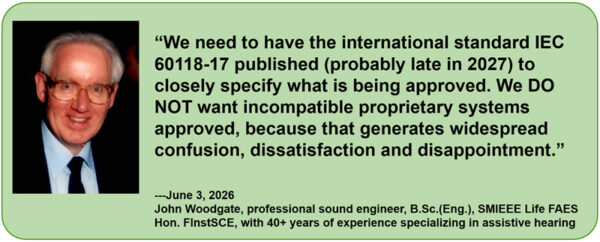
- Woodgate, JM (February 25, 2026) International Standards for Assistive Listening. IAHA (webpage)
Specifications
- IEC 60118-17 Includes Auracast streamed assistive listening. IEC TC 29 Dashboard (webpage) for the “IEC 60118-17 ED1, Electroacoustics – Hearing aids – Part 17: Assistive listening system for hearing aid users based on 2.4 GHz audio streaming.” Expected release late 2027.
- IEC 63087 (webpage). Assistive listening devices and systems for active assisted listening.
This Final Draft International Standard is an up to 6 weeks’ pre-release of the official publication. It is available for sale during its voting period: 2026-06-05 to 2026-07-17.
IEC 63087:2026 sets out the requirements for the provision of assistive listening systems (ALS) in places or situations where there is a benefit for hearing-aid, cochlear implant, and other hearing device users, compared to listening to the acoustic signal directly at that location.
This document applies to all ALS used for communication, entertainment, or educational purposes in public, private, domestic and public transport installations.
Hearing Loops

- This website: hearing loop installations
- IEC 60118-4 (webpage): Hearing loops. Electroacoustics – Hearing aids – Part 4: Induction-loop systems for hearing aid purposes – System performance requirements. Applicable to audio-frequency induction-loop systems producing an alternating magnetic field at audio frequencies and intended to provide an input signal for hearing aids operating with an induction pick-up coil (telecoil). Throughout this standard, it is assumed that the hearing aids used with it conform to all relevant parts of IEC 60118. This standard specifies requirements for the field strength in audio-frequency induction loops for hearing aid purposes, which will give adequate signal-to-noise ratio without overloading the hearing aid. The standard also specifies the minimum frequency response requirements for acceptable intelligibility. Methods for measuring the magnetic field strength are specified, and information is given on appropriate measuring equipment (see Annex B), information that should be provided to the operator and users of the system (see Annex C), and other important considerations.
- IEC 62489-1 (webpage): Electroacoustics – Audio-frequency induction loop systems for assisted hearing: Methods of measuring and specifying the performance of system components, such as neckloops
- IEC TR 63079:2017 (webpage): Code of practice for hearing-loop systems. Recommendations for and guidance on the design, planning, installation, testing, operation and maintenance of a hearing-loop system (HLS) intended for communicating speech, music and/or other signals. It is mainly concerned with HLS for hearing enhancement, in which the signals are communicated to users of hearing aids equipped with magnetic pick-up coils.
- Ampetronic hearing loop systems (webpage) help to safeguard the rights of people who experience hearing loss and ensure performance to Standard e.g. IEC 62489-1 and IEC 60118-4.

Multiple Countries
- Americans with Disabilities Act (ADA) (this website)
- Legislation and building regulations. 2018. (Ampetronic manufacturer, 8 pages, pdf)
- Global Disability Legislation. 2021. (Williams AV, 9 pages, pdf)
ISCVE (United Kingdom)
Institute of Sound, Communications and Visual Engineers Ltd
- Overview A Guide and a Code of Practice for Assistive Listening Systems (webpage). This Guide and Code of Practice have been published by the ISCVE to help venue managers, installation companies and users of Assistive Listening Systems.
- Document #1: ISCVE Guide Assistive Listening Systems (10 pages)
- Document #2: ISCVE Code of Practice for the Design and Operation of Assistive Listening Systems (66 pages)
IAHA
Assistive Listening Standards. Information and many links to a variety of standards, and background information.
“Standards for assistive listening systems are essential to ensure consistency, compatibility, and accessibility across different environments.
They help guarantee that technologies perform reliably, meet user needs, and comply with legal and regulatory requirements. By adhering to established standards, venues and manufacturers can provide inclusive experiences that work seamlessly for people with hearing loss, regardless of the setting.”