
Captions in Healthcare and Legal Settings
Patients with hearing loss can be hesitant to ask for accommodations, and these accommodations are rarely offered without requests. It is imperative that staff realize the high prevalence of hearing loss in all populations and proactively offer services that enable:
- Patients with hearing loss to understand the critical information communicated by healthcare professionals.
- Consumers with hearing loss, involved in the legal system, to understand all that is happening so they can make informed decisions.
Below are some captioning solutions for communicating effectively with people with hearing loss. These provide “auxiliary aids and services” under Effective Communication with the Americans with Disability Act (ADA).
Captions provide visual accommodations to supplement the spoken word.
Telehealth
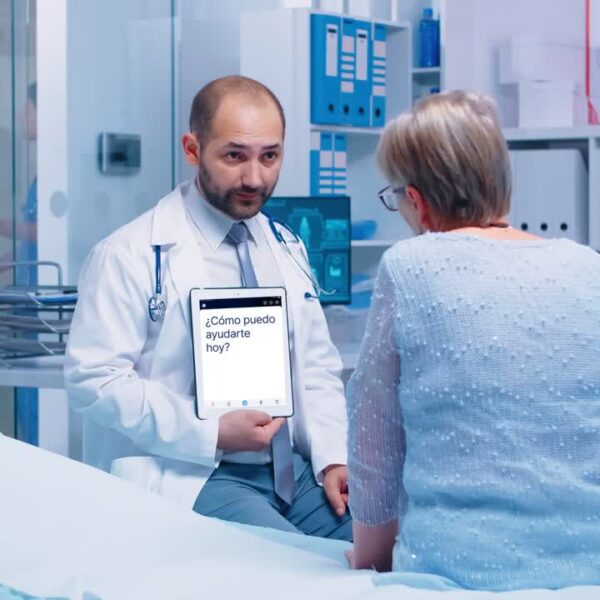
- Captions can be integrated into telehealth
- Telehealth platforms are required to have captions by the end of 2026, under the “interoperable video conferencing” section in the FCC.
Automatic Captions
(Institution provided or patient provided). See handout below.
Automatic captions are sometimes called “speech-to-text.” Smartphones, devices, and computers have apps to convert speech to text. Also many virtual meetings software (WebEx and Zoom) can have automatic captions utilized.
Automatic captions are better for shorter interactions, such as patient check-ins.
- Windows 11, for Windows and Mac, is a good option if the telehealth platform doesn’t have built-in captions. The transcription is done locally on the device, meaning audio isn’t sent to the cloud (unless configured otherwise), and thus meets HIPAA compliance.
- Ava captioning is HIPAA compliant.
- Communication Matters/Tina Childress, AuD My Favorite Captioning Apps for iOS and Android. Note, not all are HIPAA compliant.
Live Captions by Professional
(Institution provided)
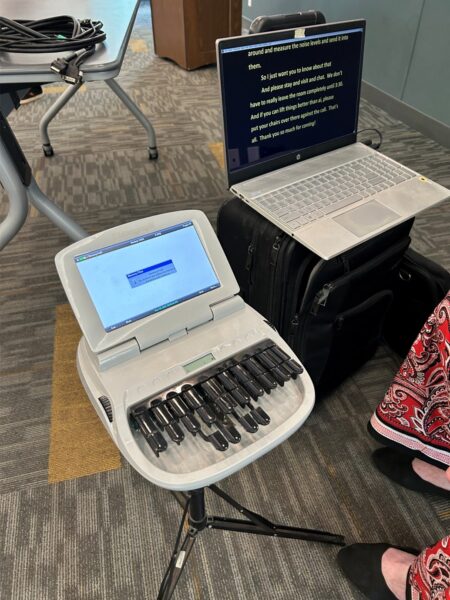
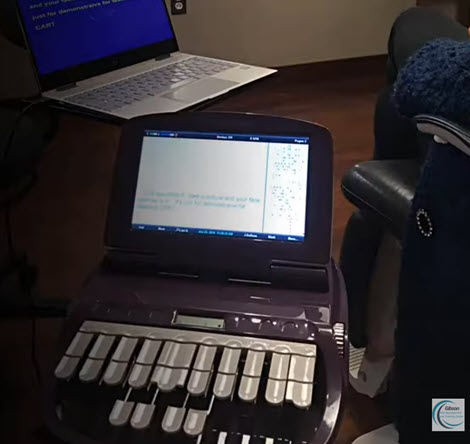
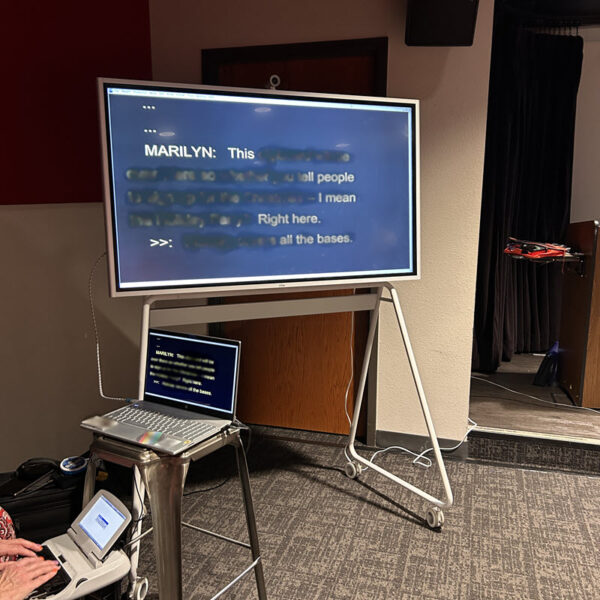
CART (Communication Access Realtime Translation). CART is an accurate, verbatim, near-instantaneous conversion of the spoken language into text by a stenographer using a stenotype machine, a laptop, and software to produce the text.
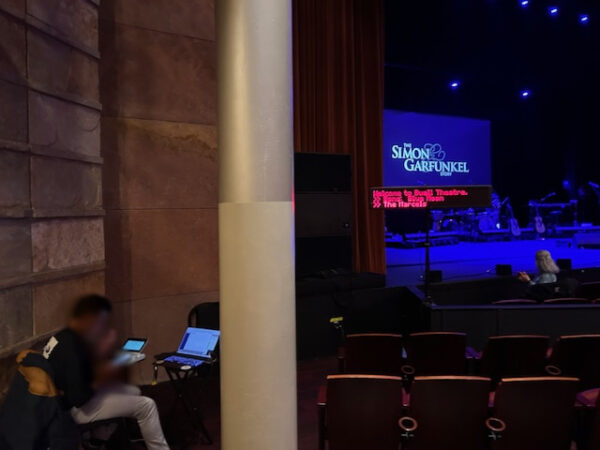
Text can be displayed on a wall, projector screen, computer screen, or on a smartphone. Text can also be embedded in virtual meeting platforms such as Zoom.
For technical accuracy, CART is preferred over automatic captions for medical or legal appointments as well as court proceedings.
- In-person CART professional: usually preferable to have the best access to sound.
- Remote CART professional: has improved immeasurably. Remember to prioritize how the mic(s) are used effectively.
- Providers need to maintain a list of CART providers.
- It’s ok for anyone, including the CART provider, to say, “Hold up – words matter, and _(insert name)_ deserves every one of them.”
Resources
- Shirley, T. CART at a medical center. White paper (1 page)
- National Court Reporters Association (NCRA)
- CART Code of Ethics
- CART Consumer Bill of Rights
- CART in the Court: Setting a Standard
- Captioning Matters (further resources)
- CART resources
- CART Information (Colorado Division of Deaf, Hard of Hearing and DeafBlind)
- All healthcare webpages (this website)
Please email the Center for Hearing Access with photos, videos, corrections, ideas, or additional products. Contact us (this website)
CART Videos
These videos show how CART can be used in other settings.
CART Services for Deaf and Hard-of-Hearing People
Source: Washington State DOITCenter (7:34)
Employment Solution Showcase: CART.
Source: AskJAN (3:27)
Follow along with the lyrics in real time, with CART closed captioning services
Source: Rochester Public Music (0:39)
Sample of CART (Communication Access Real-time Translation) services during statistics class at University of Delaware (1:55)